I'm a paragraph. Click here to add your own text and edit me. It’s easy. Just click “Edit Text” or double click me to add your own content and make changes to the font. I’m a great place for you to tell a story and let your users know a little more about you.

The Cabinet of Dr.Caligari
Inspired by the 1920 German Expressionist film
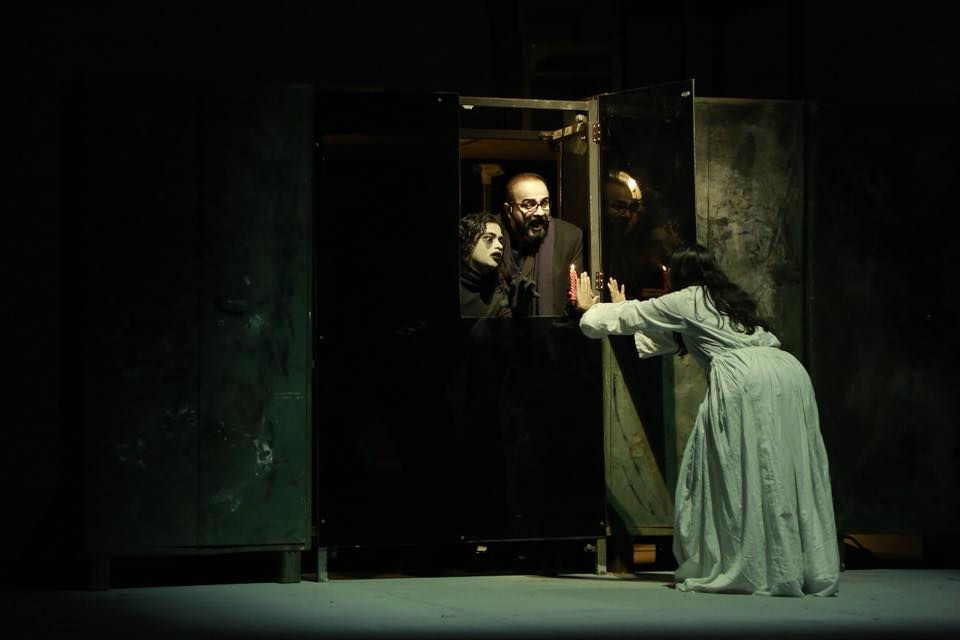
The Cabinet of Dr. Caligari is a contemporary take on the 1920 film that emerged out of spatial experimentation with a focus on objects, some found and others made. It is a multimedia performance in which the scenography and dramaturgy emerged together in an attempt to navigate through the run-down warehouse space where the production has been staged. The story of Holstenwall unfolds through multiple layers of visual narratives slowly peeling off, to keep the audiences at the edges of their seats. It tends towards an immersive experience for the spectators and engages them through a visual language that is trying to break out of the chronological narrative and place the spectator in a position to weave together the plot through a broken audio-visual narrative.
The Cabinet of Dr. Caligari attempts to explore the possibility of a theatre language in which all the aspects of theatre such as scenography, dramaturgy, actor's performance come together to make it a 'complete' experience. The form of this performance emerged as a result of a long process that lasted about five months. It began as a classroom project which primarily encouraged the students to experiment with the spatial configuration between the audience and the performer.
What began as part of the elective course: Space and Spectatorship offered by Prof. Deepan Sivaraman in Ambedkar University, the initial idea was to adapt the 1920 German Expressionist film. We devised several short performance pieces with found objects as part of classroom exercises. The Dramaturgy and Scenography evolved simultaneously working in the particular site which is a rundown warehouse, now converted into a performance space in Delhi. As much as the site-specific and post-dramatic nature of the performance, the scale of it was also completely new to me. Although I started off with the intention of being a performer, I quickly found myself involved in a lot of technical and fabrication work. With the success of several shows in the warehouse, invitations came in for a few international theatre festivals. The play was later was funded by a Bangalore based theatre company and travelled within and outside India.
Even though the narrative and scale of the performance remained the same, the texture of the performance had to change for practical reasons. Travelling with such a play gave me insight into logistical matters. The play when moved out of its site-specificity, took the form of a huge box, inside of which both the audience and performance were placed. The set was designed to be dismantled and reassembled according to requirements of every new venue, and finding a new site that is capable of accommodating the set became an important part of the process. As part of the production team, along with acting and other production works like pulley rigging I was given additional responsibilities of assembling and fabrication of set and property management.


Performed at:
Ambedkar University Delhi
18th Bharat Rang Mahotsav, NSD, Delhi
ITFOK (International Theatre Festival of Kerala)
Sangeet Natak Academy, Thrissur
The Bay Amphitheatre, RMC, Bangalore
Jawahar Kala Kendra, Jaipur
Wuzhen Theatre Festival, Wuzhen China
Maharajas College, Cochin
Produced by:
P.S Collective & NECAB
Director and Designer:
Deepan Sivaraman
Dramaturg:
Purav Goswami